The table is easier to browse in landscape — try rotating your device.
Free chemistry reference · No sign-up
The periodic table, explained element by element.
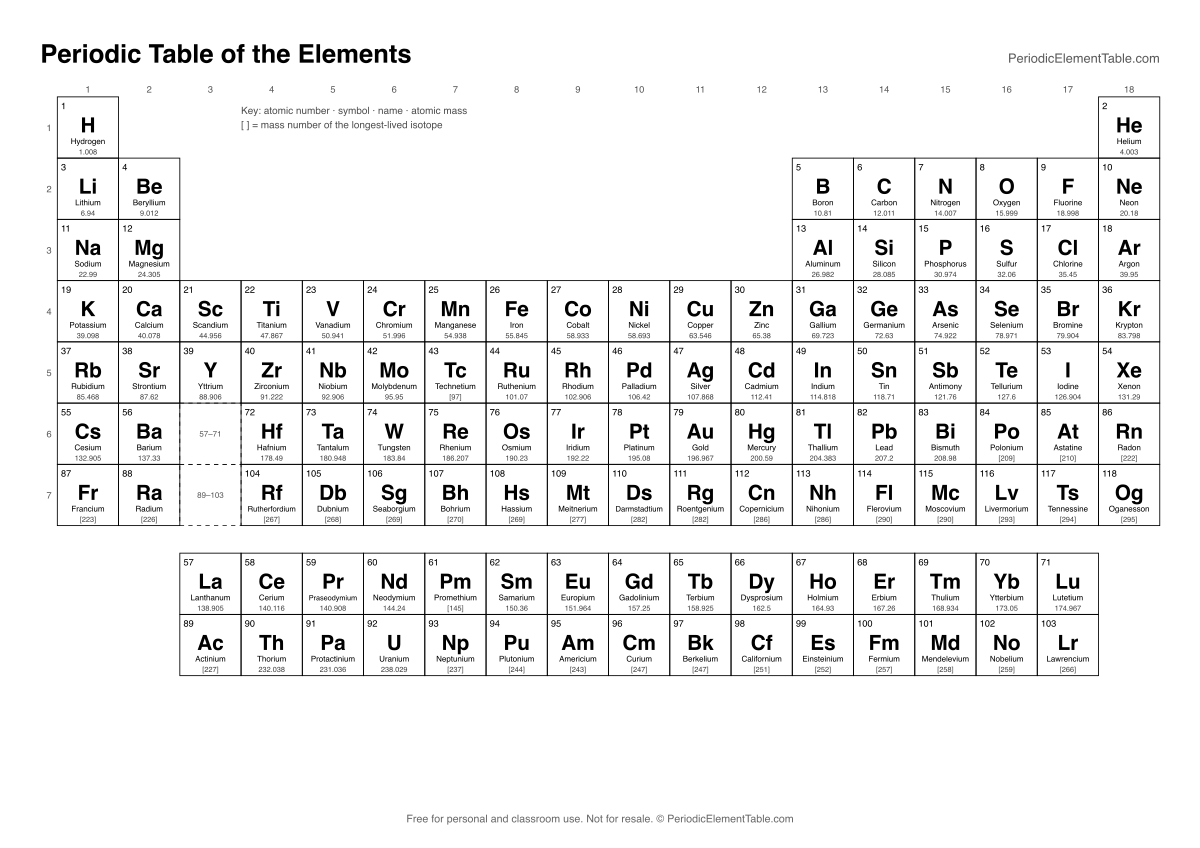
An interactive table, a full page for all 118 elements, 44 calculators and 627 study guides. Free for students, teachers, lab workers and anyone curious.
Interactive periodic table
- Alkali metal
- Alkaline earth metal
- Transition metal
- Post-transition metal
- Metalloid
- Nonmetal
- Halogen
- Noble gas
- Lanthanide
- Actinide
Element pages
A full page for every element
Click any cell in the table, or start with one of these. Each page is written from verified public data, not copied text.
- 1HHydrogen
- 2HeHelium
- 6CCarbon
- 7NNitrogen
- 8OOxygen
- 11NaSodium
- 26FeIron
- 29CuCopper
- 47AgSilver
- 79AuGold
- 80HgMercury
- 92UUranium
On every element page
- Key facts and a full property table
- Electron configuration and shell diagram
- Isotopes with half-lives and decay modes
- Common compounds
- Uses, history and an original write-up
- FAQ and links to compare elements
Calculators
Chemistry tools
44 free calculators — from unit conversions for middle school to thermodynamics for university and dosing for industry. Every one shows its working.
- Formulas & molesMost popularMolar Mass CalculatorParses any formula — parentheses, hydrates, all of it — into a full per-element mass breakdown.
- Reactions & yieldChemical Equation BalancerBalances equations automatically and shows the coefficients step by step.
- Units & measurementChemistry Unit ConverterMass, volume, temperature, pressure, energy, density and more — every unit side by side.
- Solutions, gases & pHMolarity & Dilution CalculatorMolarity, grams of solute needed, solution volume, and C₁V₁ = C₂V₂ dilutions.
- Reactions & yieldStoichiometry CalculatorGrams or moles of any reactant → amounts of every other substance, auto-balanced.
- Solutions, gases & pHpH CalculatorpH, pOH, [H⁺] and [OH⁻], plus strong and weak acid/base solutions.
- Units & measurementDensity CalculatorDensity, mass or volume in any units, with presets for common materials.
- Elements & electronsProtons, Neutrons & Electrons CalculatorSubatomic particles for any element, isotope or ion, with its nuclide symbol.
- Solutions, gases & pHTitration CalculatorUnknown concentration or volume from a titration, for any acid–base mole ratio.
- Energy & thermodynamicsSpecific Heat Calculator (q = mcΔT)Heat, mass, specific heat or temperature change, with material presets.
- Solutions, gases & pHIdeal Gas Law CalculatorSolve PV = nRT or the combined gas law in any mix of units.
- Elements & electronsElectron Configuration GeneratorFull and noble-gas notation, with an orbital box diagram, for any element.
- All tools Browse every calculator, with worked examples and FAQs on each page.
Tools for your level
- Middle school8 toolsUnit conversions, density, atoms, heat and balancing equations — the maths of first chemistry lessons.
- High school35 toolsMoles, stoichiometry, pH, gas laws, titrations and equilibria for GCSE, A level, AP and IB.
- University38 toolsThermodynamics, kinetics, electrochemistry, real gases and spectroscopy, with full working.
- Industry & lab25 toolsConcentration units, dilutions, water hardness, combustion air and ppm ↔ mg/m³ for the lab and plant.
Advertisement
Periodic trends
See the patterns
Colour the table by a property, then read why the pattern happens. Each guide opens the matching heatmap.
- Atomic Radius pm Across a periodShrinks as you move left to right across a period. Down a groupGrows as you move down a group.
- First Ionization Energy eV Across a periodRises as you move left to right across a period. Down a groupFalls as you move down a group.
- Electronegativity (Pauling scale) Across a periodRises as you move left to right across a period. Down a groupFalls as you move down a group.
- Electron Affinity eV Across a periodGenerally rises left to right across a period (with real exceptions). Down a groupGenerally falls down a group (also with exceptions).
- Melting Point K Across a periodRises through the early transition metals, then falls sharply toward the nonmetals and noble gases. Down a groupVaries by block — generally falls down the main-group metals, but the pattern is less consistent among nonmetals.
- Boiling Point K Across a periodFollows roughly the same shape as melting point — peaks among the mid-transition metals, drops toward the nonmetals. Down a groupVaries by block, similarly to melting point.
- Density g/cm³ Across a periodTends to rise through the transition metals, then fall toward the lighter nonmetals. Down a groupGenerally rises down a group.
- Atomic Mass u Across a periodRises steadily left to right (each element has one more proton, and generally more neutrons). Down a groupRises steadily down a group.
Or switch the table above into heatmap, temperature or discovery-year mode. Periodic table ↑
Chemistry library
Learn the concepts
627 original articles on 16 shelves: explainers, worked examples, practice questions, lab guides and study guides.
Browse by subject
- Bonding & Molecular Structure 135
- Biochemistry & the Chemistry of Life 129
- Atomic Structure 105
- Lab Techniques & Analysis 93
- Acids, Bases & Salts 82
- The Periodic Table & Elements 39
- Moles & Chemical Calculations 12
- Nuclear Chemistry & Radioactivity 7
- Gases, Liquids, Solids & Solutions 6
- History & Famous Chemists 6
- Chemical Reactions 4
- Energy, Rates & Equilibrium 3
- Redox & Electrochemistry 2
- Environmental & Earth Chemistry 2
- Materials & Industrial Chemistry 1
- Study Guides & Teaching 1
Newest articles
- Amorphous vs Crystalline Solids: What's the Difference?Crystalline solids have long-range order; amorphous solids don't. Compare melting, fracture, X-ray patterns and uses, with quartz vs glass as the key example.Read the article
- Average Bond Enthalpies: A Reference Table with ExplanationsA grouped table of average bond enthalpies in kJ/mol, from H–H to N≡N, with the reason behind each pattern and the difference from bond dissociation energy.Read the article
- Which Substances Conduct Electricity, and Why?Metals conduct, salt solution conducts, solid salt and sugar solution don't. One rule explains them all: you need charged particles that are free to move.Read the article
For teachers & students
Free to print, free to share
We'd love to hear from you
Did this site help you?
Tell us how you use PeriodicElementTable.com, what helped you learn, what's missing, or anything that looks wrong. We read every message, and reader feedback shapes what we build next.
Follow us
Element data comes from PubChem, NIST, the IAEA and IUPAC, and every article is written for this site. No sign-up, no paywall. About the site →